Who counts as a DSE user? The test, and the grey areas
· 6 min read
The short answer
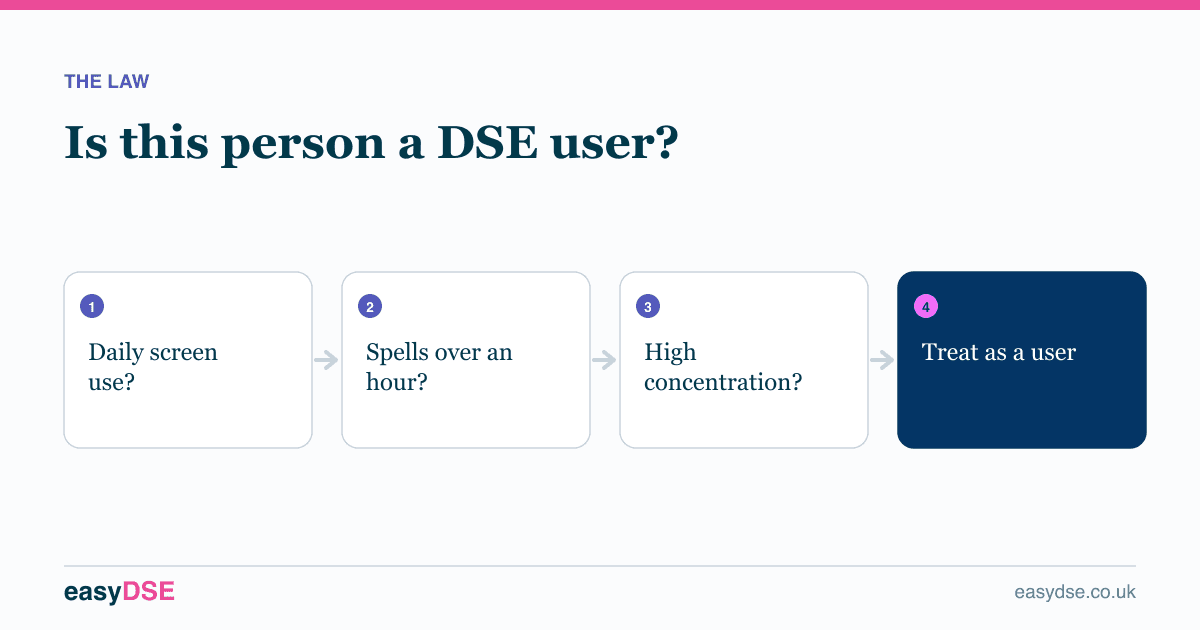
A DSE user is someone who habitually uses display screen equipment as a significant part of their normal work. There is no statutory hour threshold. HSE guidance points at daily use, unbroken spells of an hour or more, and work needing high concentration or fast information transfer.
Almost every employer asking about DSE eventually asks the same question: how many hours a day does someone have to be at a screen before the rules apply? The answer frustrates people, because there is no number in the regulations.
What the regulations say
The duties attach to a user, defined as an employee who habitually uses display screen equipment as a significant part of their normal work. Both words are doing work there. Habitually rules out the occasional. Significant rules out the trivial.
Parliament left it qualitative on purpose. A hard threshold would have been gamed, and it would have aged badly as work changed.
The factors HSE guidance points at
The guidance sets out indicators rather than a test to pass. Someone is more likely to be a user if they:
- normally use DSE for continuous spells of an hour or more at a time
- use it more or less daily
- have to transfer information quickly to or from the screen
- need to apply high levels of attention and concentration at the screen
- are highly dependent on DSE, with little choice about using it
- need particular training or skills to use the equipment
The grey areas
Part-time and job-share staff
Working three days a week does not make someone a non-user. What matters is the pattern of their working day, not how many days they work. Somebody at a screen for six hours on each of three days is clearly a user.
Field staff and drivers
Someone who spends most of the day on site but writes up reports on a laptop each evening may well be a user, and their workstation is wherever they do that writing up. This group is routinely missed, and they often have the worst setups.
Hot-deskers and shared workstations
Shared desks do not dilute the duty. If anything they raise the risk, because a shared workstation gets set for nobody. Assess the people, and make sure the workstation adjusts to fit each of them.
Agency workers and contractors
The regulations also cover operators, meaning self-employed people doing the same work. If you control the workstation, you hold the duty for it. With agency staff, the practical answer is usually that the host employer assesses the workstation, because they are the one who can change it.
Occasional and short-term use
Someone who checks email on a tablet for ten minutes a day is not a user. Somebody drafted in to cover a screen-heavy role for a month probably is, for that month.
What follows from being a user
| Entitlement | Applies to users? |
|---|---|
| Workstation assessment | Yes |
| Eye and eyesight test on request, employer funded | Yes |
| Glasses for screen distance where needed | Yes |
| Breaks or changes of activity planned into the work | Yes |
| Health and safety training on the workstation | Yes |
| Information about the assessment and the risks | Yes |
How to record the decision
Write down who you have classed as a user and why, in a sentence each. It takes half an hour for a small business and it is the first thing you will want if the decision is ever questioned.
Frequently asked questions
How many hours a day makes someone a DSE user?
There is no legal hour threshold. HSE guidance points at continuous spells of an hour or more, near-daily use, and work requiring high concentration or fast information transfer, but the test is qualitative.
Are part-time staff DSE users?
They can be. What matters is the pattern of their working day rather than how many days a week they work.
Do DSE rules apply to agency workers?
The regulations cover users and operators, including self-employed contractors doing the same work. In practice the employer who controls the workstation carries out the assessment.
Assess your own workstation, free
Eight minutes online, with a report you can act on.
Read next
This article is general information about UK health and safety law, not legal advice. Check the current position on the HSE website and take advice where the stakes justify it.