Home working DSE assessments: what employers must actually do
· 7 min read
The short answer
DSE duties follow the work, not the building. For home workers that means a self-assessment of the home setup, acting on what it finds, and keeping the record. You are not required to visit or inspect the home.
Home working generates more DSE questions than anything else, mostly because employers assume the duty either disappears at the front door or requires them to turn up at it. Neither is right.
The duty follows the work
The Health and Safety (Display Screen Equipment) Regulations 1992 apply to DSE users wherever they work. A home worker who uses a screen as a significant part of their job is a user, and their home workstation is a workstation.
The Management of Health and Safety at Work Regulations 1999 sit alongside, requiring a suitable and sufficient assessment of risks to employees, again regardless of location.
What you are not required to do
You are not required to visit the home, inspect it, or approve the room. HSE has been consistently pragmatic about this: for home workers the practical route is a self-assessment completed by the employee, reviewed by the employer, and acted upon.
What home assessments typically find
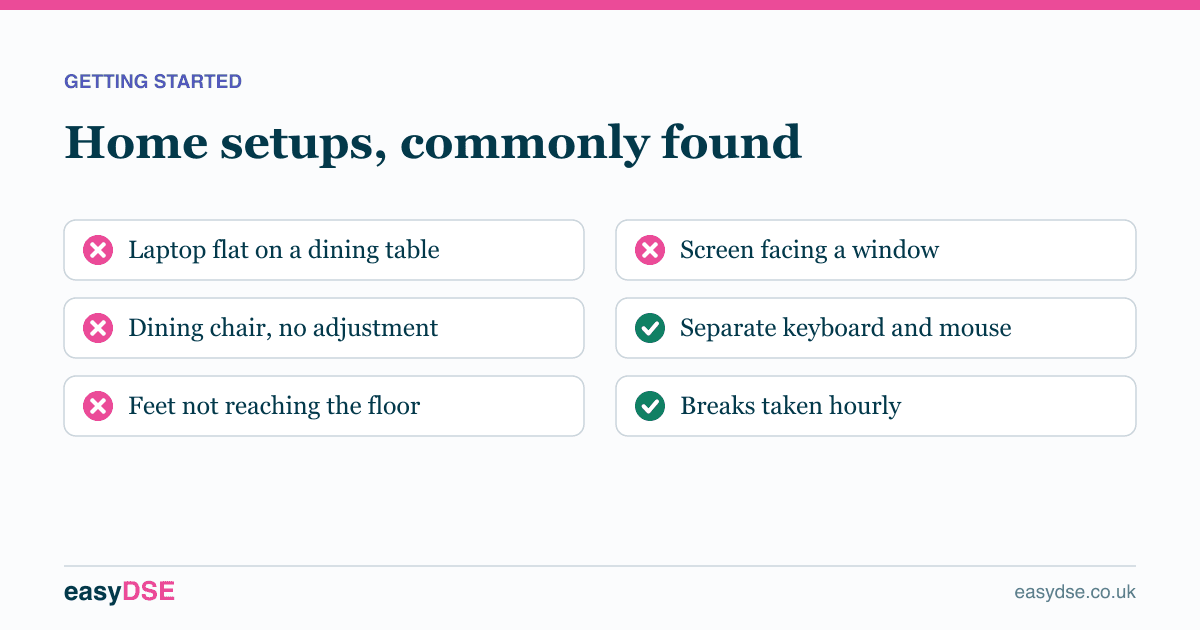
The pattern is remarkably consistent, and it is not the pattern you get in an office:
- A laptop used flat on a table, so the screen sits well below eye level.
- A dining chair with no height or backrest adjustment.
- A dining table five to ten centimetres higher than a desk, pushing the shoulders up.
- Feet dangling once the chair is raised to suit the table.
- A screen facing or backing onto a window, with no blind.
- Long unbroken stretches, because the commute and the walk to a meeting room have gone.
Four of those six are fixed by a laptop stand, a separate keyboard and mouse, and a footrest.
A workable process for a small business
- Assess at the point of change
- When someone starts home working, not six months later. Tie it to the flexible working approval or the onboarding checklist.
- Use a self-assessment they can do at the desk
- Something short enough that they complete it honestly, and specific enough to surface the six issues above.
- Review and respond
- Someone has to read it. High-severity findings need an action and a date against them.
- Issue standard equipment
- Rather than assessing the same finding repeatedly, default to issuing a stand, keyboard and mouse to laptop users.
- Keep the record
- The assessment, the findings, what you did, and when.
Who pays for the equipment
Where an assessment identifies a risk, the employer has a duty to reduce it. In practice that means the employer provides what is needed. You cannot discharge a statutory duty by asking the employee to buy their own chair.
That said, the equipment that resolves most home working findings is inexpensive, and it belongs to you rather than to them.
What about the rest of the house
Your duty relates to the work and the workstation, not the general condition of someone’s home. You are not responsible for their wiring or their stair carpet. You are responsible for the equipment you provide and the way the work is organised.
Frequently asked questions
Do I have to do a DSE assessment for home workers?
Yes. DSE duties follow the work rather than the premises. A self-assessment completed by the employee and acted on by the employer is the standard approach.
Do employers have to visit employees’ homes?
No. There is no requirement to inspect the home. Self-assessment, reviewed and acted upon, is the recognised route for home workers.
Who pays for home office equipment?
Where the assessment identifies a risk, the employer has a duty to reduce it, which in practice means providing the equipment needed to fix the finding.
Assess your own workstation, free
Eight minutes online, with a report you can act on.
Read next
This article is general information about UK health and safety law, not legal advice. Check the current position on the HSE website and take advice where the stakes justify it.