Reasonable adjustments for screen workers under the Equality Act
· 6 min read
The short answer
The Equality Act 2010 requires employers to make reasonable adjustments where a disabled person is placed at a substantial disadvantage. For screen workers that duty runs alongside DSE duties and usually needs a specialist assessment rather than a generic checklist.
A generic DSE self-assessment is a good screening tool and a poor specialist one. Where someone has a disability or a long-term health condition affecting screen work, a second duty applies and it is more demanding.
Two duties, running in parallel
| DSE Regulations 1992 | Equality Act 2010 | |
|---|---|---|
| Applies to | All DSE users | Disabled people as defined by the Act |
| Standard | Assess and reduce risk | Take reasonable steps to remove a substantial disadvantage |
| Triggered by | Being a user | Knowledge, actual or constructive, of the disability |
| Typical output | Workstation changes | Individual adjustments to equipment, role or hours |
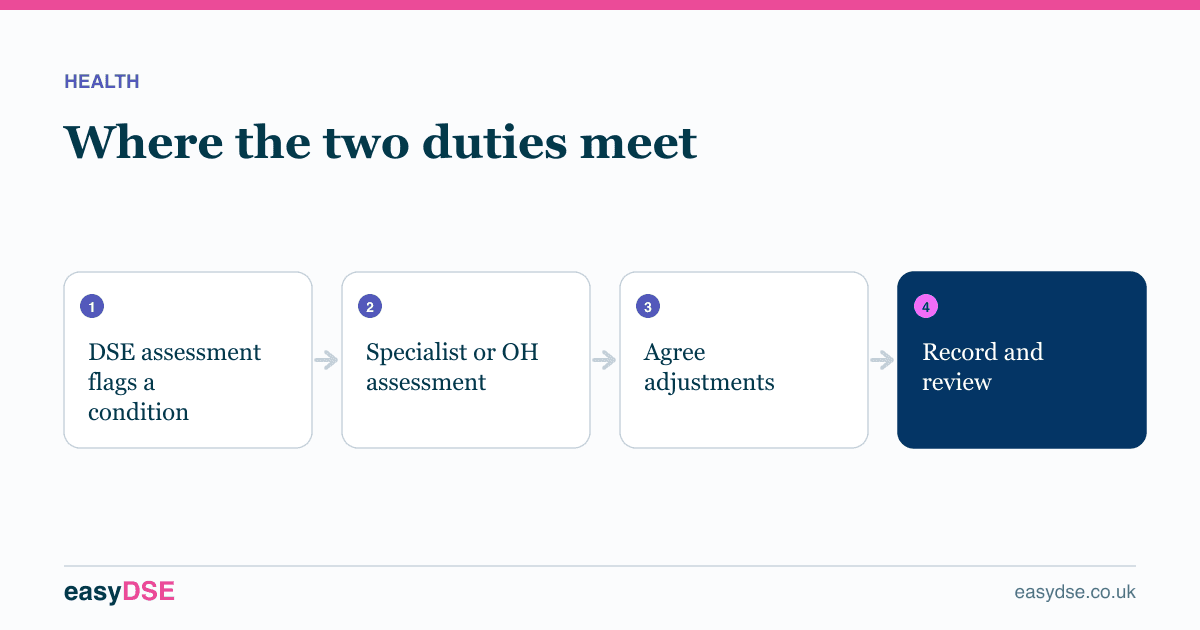
The practical relationship is that the DSE assessment often identifies the issue, and the Equality Act duty determines how far you have to go in response.
What counts as a disability
Under the Act, a physical or mental impairment with a substantial and long-term adverse effect on the ability to carry out normal day-to-day activities. Long-term generally means twelve months or more, or likely to be.
That covers a great deal more than people assume: chronic back conditions, arthritis, repetitive strain injuries, visual impairments, hearing loss, long Covid, ME, dyslexia, ADHD, autism, anxiety and depression can all qualify depending on effect.
What "reasonable" means in practice
Reasonableness is assessed against the size and resources of the employer, the cost, the practicality, and how effective the adjustment would be. A small business is not held to the same standard as a large corporate, but small does not mean exempt.
Most screen-work adjustments are inexpensive, which makes them harder to argue are unreasonable.
Adjustments that come up often
- Equipment
- Specialist chairs and seating supports, split or single-handed keyboards, alternative pointing devices, larger or higher-resolution screens.
- Software
- Screen readers, magnification, dictation, colour overlays, focus and reading tools.
- Environment
- A quieter location, a fixed desk rather than hot-desking, control over lighting.
- Work pattern
- More frequent breaks, adjusted hours, phased return, reduced screen-continuous tasks.
- Process
- Written instructions rather than verbal, more notice of changes, adjusted performance measures.
Getting specialist input
For anything beyond the obvious, get an occupational health or specialist assessment. It gives you a documented basis for the adjustments you make, and for any you conclude are not reasonable.
Access to Work can fund equipment and support for eligible employees, which frequently changes what is reasonable for a small employer to provide.
Record the conversation, not just the outcome
Note what was requested, what you considered, what you agreed, and where you declined something, why. The reasoning is what gets examined if the decision is ever challenged.
Frequently asked questions
Are employers required to provide specialist equipment for disabled employees?
Where a disabled person is placed at a substantial disadvantage, the Equality Act 2010 requires reasonable steps to remove it. Most screen-work adjustments are inexpensive, which makes them difficult to argue are unreasonable.
Does a DSE assessment satisfy the Equality Act duty?
No. A DSE assessment often identifies the issue, but the Equality Act duty is individual and usually needs specialist or occupational health input.
Can Access to Work help?
Yes. It can fund equipment and support for eligible employees, which often changes what is reasonable for a smaller employer to provide.
Assess your own workstation, free
Eight minutes online, with a report you can act on.
Read next
This article is general information about UK health and safety law, not legal advice. Check the current position on the HSE website and take advice where the stakes justify it.