DSE and pregnancy: the individual risk assessment employers owe
· 5 min read
The short answer
Once an employer is notified in writing of a pregnancy, the Management of Health and Safety at Work Regulations 1999 require an individual risk assessment, reviewed as the pregnancy progresses. For screen workers the practical issues are comfort, posture, breaks and access to a toilet.
Pregnancy is one of the few situations where a generic DSE self-assessment is clearly not enough on its own. A separate and more specific duty applies, and it sits in different regulations from the DSE ones.
Where the duty comes from
Regulation 16 of the Management of Health and Safety at Work Regulations 1999 requires employers to assess risks to new and expectant mothers where the work could involve risk to her or her baby, and to take action to avoid that risk.
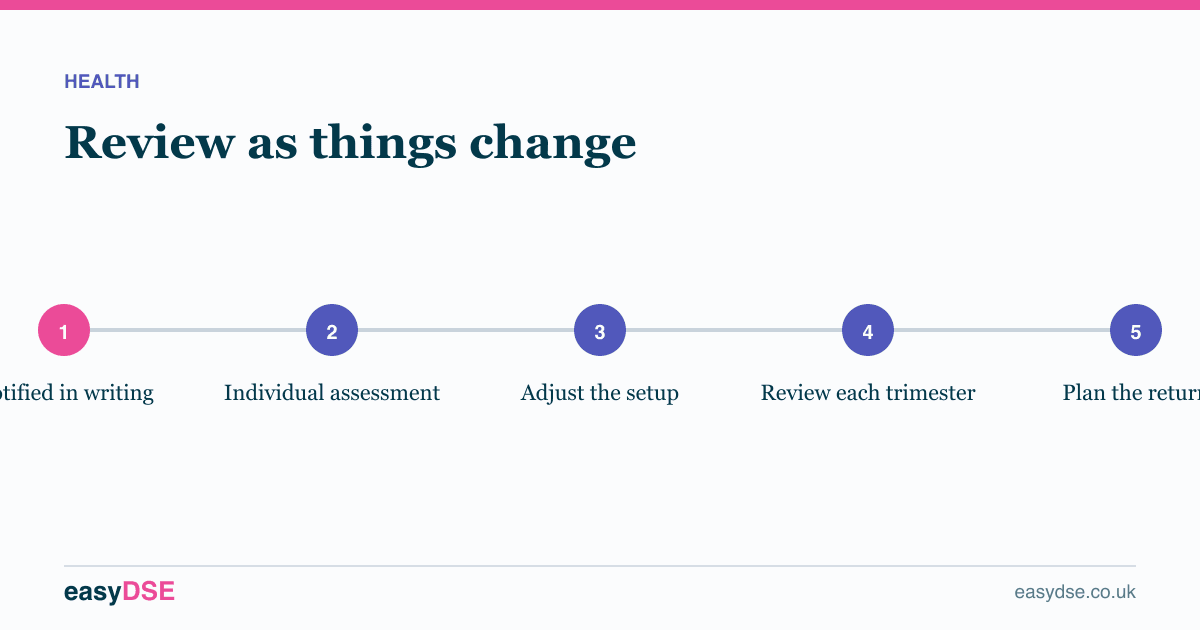
The trigger is written notification. Once you have been told in writing that an employee is pregnant, has given birth in the last six months, or is breastfeeding, the individual assessment duty is live.
What actually matters for screen workers
- Changing body shape
- Desk position, seat depth and chair fit all change through a pregnancy. What worked in month three may not in month seven.
- Back and pelvic discomfort
- Common, and made considerably worse by long static sitting. Lumbar support and frequent movement matter more than usual.
- Circulation and swelling
- Sitting still for long periods contributes. A footrest and regular movement help.
- More frequent breaks
- Including access to a toilet without asking, and somewhere to rest. Regulation 25 of the Workplace Regulations requires suitable rest facilities for pregnant workers.
- Fatigue and nausea
- Affects concentration and tolerance for long screen spells, particularly early on.
Practical adjustments that usually help
- Move the desk out or use a keyboard tray so there is room to sit close without leaning.
- Add or improve lumbar support, and check seat depth as things change.
- Add a footrest, which helps both posture and circulation.
- Agree more frequent breaks explicitly rather than leaving it to be negotiated each time.
- Allow more home working or a flexible start if commuting is difficult.
- Make sure there is somewhere to rest, as the Workplace Regulations require.
Review it, do not do it once
The duty is ongoing. What is comfortable at twelve weeks will not be at thirty. A sensible cadence is a review each trimester and whenever the employee raises something.
The return to work after maternity leave is also a review point, particularly where someone is breastfeeding or the role has changed.
Recording it
Keep the individual assessment separate from the general DSE record, treat it as special category health data, and limit access to the people who need it to act.
Frequently asked questions
Do pregnant employees need a separate risk assessment?
Yes. Once notified in writing, the Management of Health and Safety at Work Regulations 1999 require an individual risk assessment for new and expectant mothers, reviewed as circumstances change.
Is computer screen use dangerous during pregnancy?
HSE guidance is clear that display screen equipment does not present a radiation risk. The relevant issues are posture, comfort, circulation, fatigue and access to breaks and rest facilities.
Assess your own workstation, free
Eight minutes online, with a report you can act on.
Read next
This article is general information about UK health and safety law, not legal advice. Check the current position on the HSE website and take advice where the stakes justify it.