Set up your office chair properly in five minutes
· 5 min read
The short answer
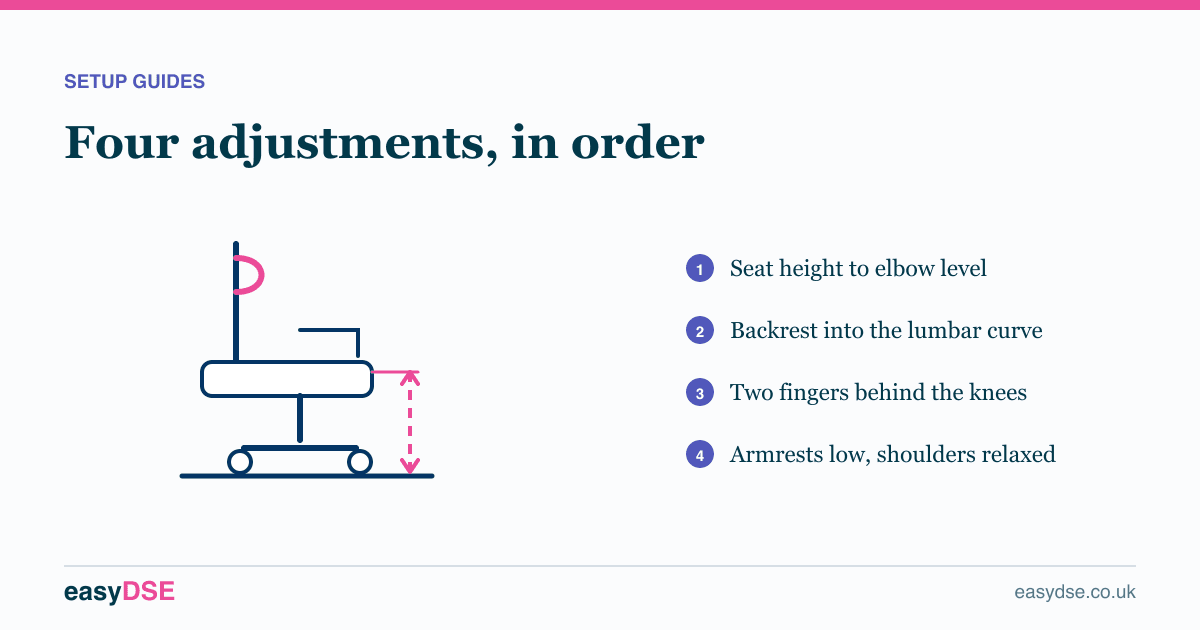
Adjust a chair in this order: seat height so forearms are level with the desk, backrest height so the lumbar curve is supported, seat depth for a two-finger gap behind the knees, then armrests low enough that shoulders relax. Add a footrest if feet no longer reach the floor.
An adjustable chair left on its factory settings performs no better than a fixed one. Most people never touch the levers, usually because it is not obvious what they do or what order to use them in. Here is the order.
Step one: seat height
Sit right back in the chair and raise or lower the seat until your forearms are level with the desk surface and your elbows sit at roughly a right angle, close to your sides.
Set this from the desk, not from the floor. The desk height is fixed and your chair is not, so the chair adapts to the desk.
Step two: feet
Now look at your feet. If they are flat on the floor, good. If they dangle or only your toes reach, you need a footrest. Do not lower the chair to reach the floor, because that puts your forearms below the desk and your wrists into extension.
Step three: the backrest
Raise or lower the backrest so the lumbar pad, the part that curves outwards, meets the small of your back. Sit fully back so you are actually using it. A backrest you never touch supports nothing.
If the chair has recline tension, set it so the backrest follows you as you move rather than either flopping back or feeling locked.
Step four: seat depth
You want roughly a two-finger gap between the front edge of the seat and the back of your knees. Too deep and the edge presses behind the knee, restricting circulation. Too shallow and your thighs are unsupported.
If your chair has no seat slide, a firm cushion behind your back achieves the same thing for a few pounds.
Step five: armrests
Armrests should support your forearms without lifting your shoulders. If they hold your shoulders up, lower them. If they stop you getting close enough to the desk, lower them further or take them off.
If your chair does not adjust
A dining chair, stool or sofa is not a work chair, and Schedule 1 requires a chair that is stable, allows easy movement and is adjustable in seat height and backrest height and tilt. That is a legal requirement rather than an upgrade.
A usable adjustable task chair starts at around a hundred and fifty pounds. In the meantime a lumbar cushion and a footrest will take the edge off.
Then stop sitting still
The best posture is the next one. Even a perfectly set chair is uncomfortable if you hold one position for three hours. Change position often and stand up at least once an hour.
Frequently asked questions
What order should I adjust an office chair in?
Seat height first, set from the desk so forearms are level. Then check your feet and add a footrest if needed. Then backrest height, then seat depth, then armrests.
Can I use a dining chair for working from home?
Not for sustained work. The regulations require a work chair that is stable and adjustable in seat height and backrest height and tilt. A dining chair meets none of that.
Assess your own workstation, free
Eight minutes online, with a report you can act on.
Read next
This article is general information about UK health and safety law, not legal advice. Check the current position on the HSE website and take advice where the stakes justify it.