How to run free DSE assessments across a small team
· 7 min read
The short answer
You can assess a small team for nothing using a free online self-assessment. The work is in reviewing the results, fixing the high-priority findings, keeping the records and repeating annually. Paid tools earn their keep once chasing and record keeping start costing you time.
If you run a business with fewer than about fifty screen workers and no health and safety department, this is the cheapest defensible way to meet your DSE duties. It takes an afternoon to set up and a couple of hours a year to maintain.
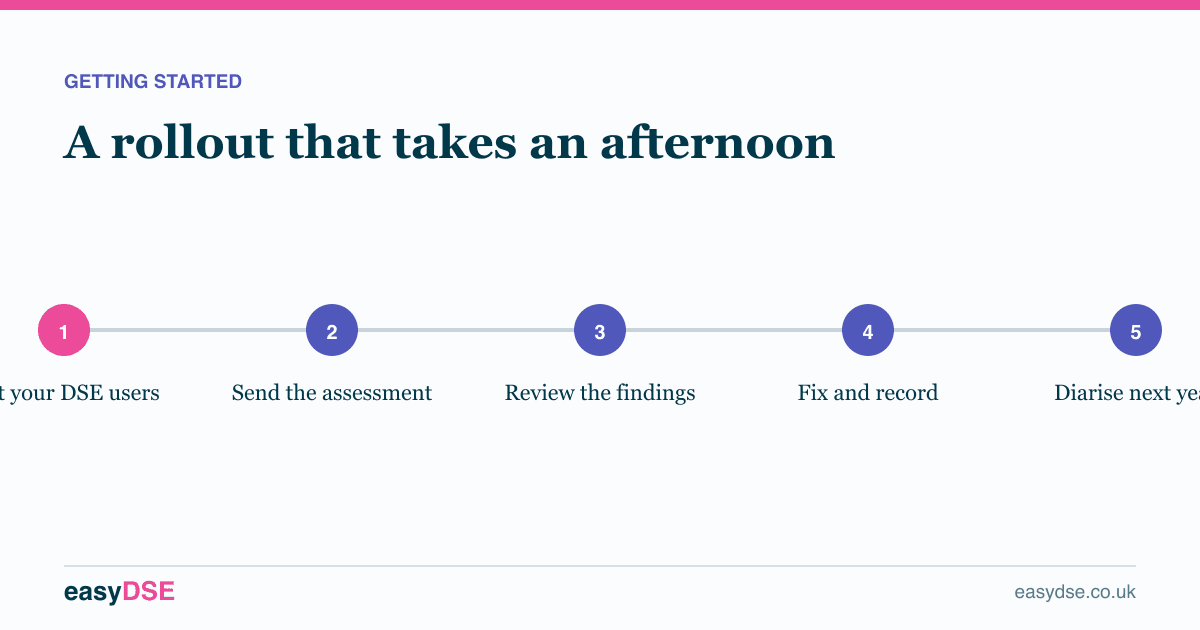
Step one: list your DSE users
Write down everyone who uses a screen as a significant part of their job. Include home workers, hybrid workers, part-timers and anyone field-based who writes up on a laptop. Note against each name why you classed them as a user or not.
This list is the foundation of everything else, and it is the first thing anyone will ask to see.
Step two: choose an assessment
You need something that covers the Schedule 1 minimums: screen, keyboard, mouse, desk, chair, environment, software and work organisation. HSE publishes a workstation checklist you can print, and there are free online tools that do the same thing with the arithmetic done for you.
- Paper checklists
- Free and thorough. Downside is that you get paper back, which someone has to read, interpret and file.
- Free online tools
- Same coverage, with findings prioritised automatically and a report produced for each person.
- Paid platforms
- Add central tracking, automatic chasing and record retention. Worth it once the admin outweighs the cost.
Step three: send it, and explain why
Response rates depend almost entirely on the covering message. Two sentences on why it matters to them, not to you, is worth more than any reminder schedule.
Step four: read the results properly
This is the step small businesses skip, and it is the one the law actually cares about. Sort the findings by severity and deal with the high ones first.
Expect a pattern. In most small businesses the same three or four issues account for most of the risk: laptops used flat, chairs that do not adjust, mice out of reach, and nobody taking breaks. Fixing those four across the business is more valuable than perfecting one person’s desk.
Step five: act, and write down what you did
Against each high-priority finding, record what you did and when. Bought a stand. Moved the desk. Referred to occupational health. Discussed workload.
A finding with a dated action next to it is evidence of compliance. A finding on its own is evidence of knowledge without action, which is worse than having no assessment at all.
Step six: diarise the next one
Most employers work on an annual cycle. Put it in the calendar now, and also review whenever someone changes desk, moves to home working, reports discomfort, becomes pregnant or returns from a related absence.
When free stops being free
Free works well up to a point. The point is usually reached when:
- chasing non-responders is taking someone a day a month
- you cannot answer the question "who has not done theirs" without a spreadsheet exercise
- reports live in an inbox rather than anywhere you could produce them from
- annual reassessment has quietly stopped happening
At that stage a low-cost platform usually costs less than the time it replaces. The assessments themselves stay free for the individual either way.
Frequently asked questions
Can I do DSE assessments for free?
Yes. Free self-assessment tools and the HSE workstation checklist both cover the legal requirements. The cost comes from acting on the findings, and most common fixes are adjustments rather than purchases.
How often should a small business repeat DSE assessments?
Annually is the usual cycle, plus a review whenever the workstation or the person changes significantly.
Assess your own workstation, free
Eight minutes online, with a report you can act on.
Read next
This article is general information about UK health and safety law, not legal advice. Check the current position on the HSE website and take advice where the stakes justify it.