Eight DSE mistakes small businesses make
· 6 min read
The short answer
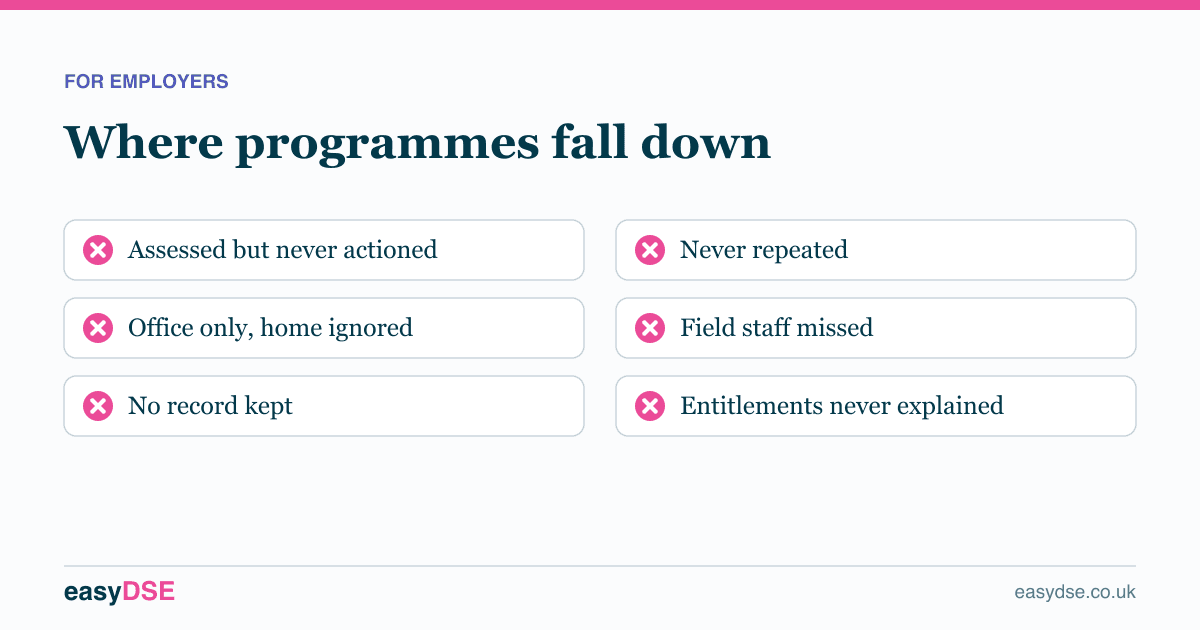
The common failures are assuming the rules are for larger firms, ignoring home setups, treating the assessment as the deliverable, keeping no records, never repeating it, missing field staff, skipping the software and work organisation questions, and not telling people their entitlements.
These come up again and again in small businesses. None of them is unusual, and all of them are cheap to fix once you have noticed.
1. Assuming the rules are for bigger companies
There is no small business exemption in the DSE regulations. No headcount threshold, no lighter touch regime. A business with four employees carries the same duties as one with four thousand.
2. Assessing the office and ignoring the kitchen table
The regulations follow the work, not the building. If someone does two days a week at home, that setup needs assessing too, and it is usually the worse of the two.
3. Treating the assessment as the deliverable
The assessment is not the compliance. Acting on it is. A folder full of completed assessments with no corresponding actions is a liability rather than a defence.
4. Keeping no usable record
Assessments returned by email, scattered across inboxes, unretrievable eighteen months later. If you cannot produce a named person’s assessment quickly, you effectively do not have one.
5. Doing it once
People change desks, move to home working, get new equipment and develop conditions. A three-year-old assessment describes a workstation that may no longer exist.
6. Missing the people without desks
Field engineers, drivers, site managers and anyone who writes up on a laptop in a van or a hotel room. They are frequently DSE users, they are almost always missed, and their setups are usually the worst in the business.
7. Skipping the software and work organisation questions
Schedule 1 covers software suitability and system response speed, and regulation 4 covers how work is planned. These are in scope, and they are often where the real risk sits in machine-paced roles like support queues and data entry.
8. Never telling people what they are entitled to
Regulation 7 requires you to inform users about eye tests and breaks. Nobody asking for an eye test is not evidence that nobody needs one. It is usually evidence that nobody knows they can.
Fixing all eight in a week
- Write the user list, including home and field workers.
- Send an assessment that covers all of Schedule 1, including software and work pattern.
- Sort the findings by severity, fix the high ones, and date each action.
- Put the assessments and the action log somewhere retrievable.
- Send a short note telling people about eye tests and breaks.
- Diarise the next round.
Frequently asked questions
What is the most common DSE compliance failure?
Completing assessments and not acting on the findings. An unactioned assessment demonstrates that the employer knew about a risk and did nothing, which is worse than not assessing at all.
Do DSE rules apply to employees working from home?
Yes. The regulations follow the work rather than the premises, so home workers who are DSE users must be assessed.
Assess your own workstation, free
Eight minutes online, with a report you can act on.
Read next
This article is general information about UK health and safety law, not legal advice. Check the current position on the HSE website and take advice where the stakes justify it.