Breaks and the law: what "periodically interrupted" actually means
· 5 min read
The short answer
Regulation 4 requires employers to plan DSE work so it is periodically interrupted by breaks or changes of activity. No schedule is prescribed. The guidance favours short, frequent breaks taken before fatigue sets in, rather than long occasional ones.
Regulation 4 says employers must plan the activities of DSE users so their daily work on display screen equipment is periodically interrupted by breaks or changes of activity that reduce their workload at the screen.
What it does not say is how long, how often, or what counts. That is deliberate, and it means the duty is about how you design the job rather than about installing a timer.
The shape the guidance recommends
Three principles come through consistently in HSE guidance:
- Short and frequent
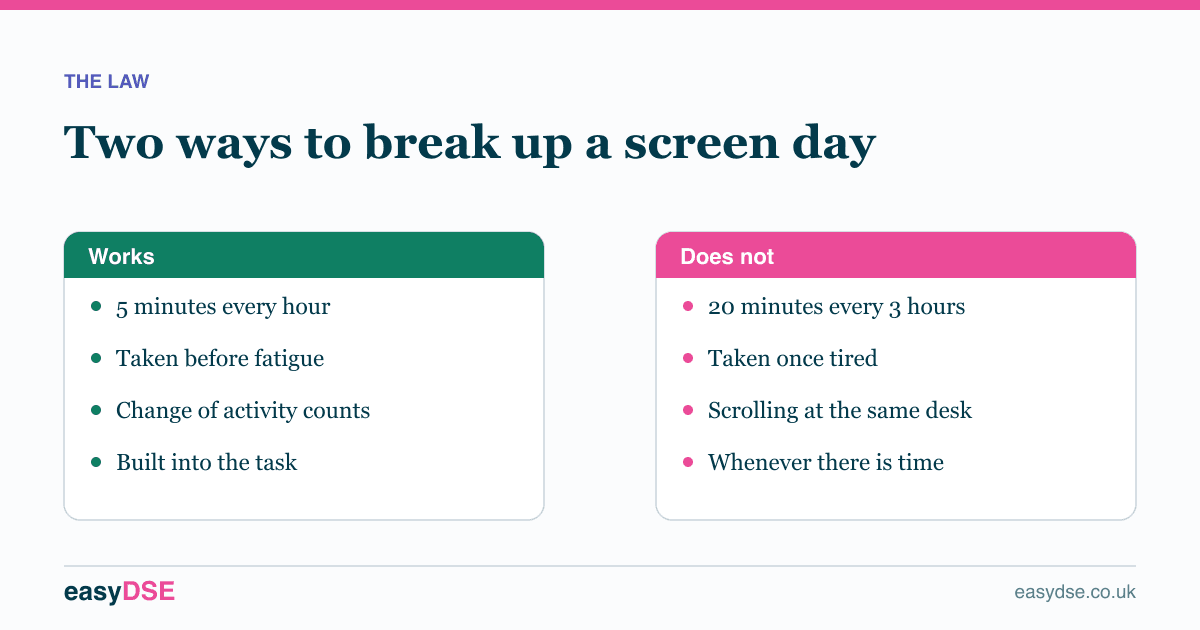
- Brief breaks taken often are more effective than longer breaks taken occasionally. Five minutes an hour beats twenty minutes every three.
- Before fatigue, not after
- A break is preventive. Once someone is aching or losing concentration, the break is remedial and less effective.
- A change counts
- The break does not have to be idle time. Moving to a task away from the screen achieves the same thing.
What counts as a break
The test is whether the workload at the screen genuinely reduces. Making a phone call at the same desk while still reading the screen does not count. Getting up to collect something, having a conversation, doing paperwork, or running a meeting away from the screen all do.
Building it into a small business
Most small employers do not need a policy document. They need the work designed so the breaks happen naturally:
- Batch off-screen tasks rather than letting them fill gaps. Reading, calls and filing are natural interruptions.
- Use task boundaries as prompts. End of a call, document sent, meeting finished. Stand up.
- Avoid back-to-back video calls. Schedule 50 minutes instead of 60 and the break happens by default.
- For roles with no natural variety, such as data entry or support queues, build the breaks into the rota explicitly.
Where the duty bites hardest
Roles with machine-paced work and little autonomy carry the greatest risk, because the person cannot create their own breaks. Contact centres, transcription, claims processing and moderation queues are the classic examples.
If your assessment shows someone regularly works more than two hours without leaving the screen, that is a finding to act on, not a personality trait to accept.
How this interacts with the Working Time Regulations
The two sets of rules are separate. The Working Time Regulations 1998 give most workers a 20 minute rest break when the working day is longer than six hours. The DSE duty sits on top of that and is about the pattern of screen work through the day, not the statutory rest break.
Frequently asked questions
How long should a DSE break be?
The regulations set no length. Guidance favours short, frequent breaks, commonly around five minutes away from the screen every hour, taken before fatigue sets in.
Does a change of task count as a DSE break?
Yes, as long as it genuinely reduces the workload at the screen. A phone call taken while still reading the screen does not count.
Is the DSE break the same as the legal rest break?
No. The statutory rest break under the Working Time Regulations is separate. The DSE duty concerns how screen work is broken up across the day.
Assess your own workstation, free
Eight minutes online, with a report you can act on.
Read next
This article is general information about UK health and safety law, not legal advice. Check the current position on the HSE website and take advice where the stakes justify it.