DSE eye tests: who pays, how often, and what actually counts
· 5 min read
The short answer
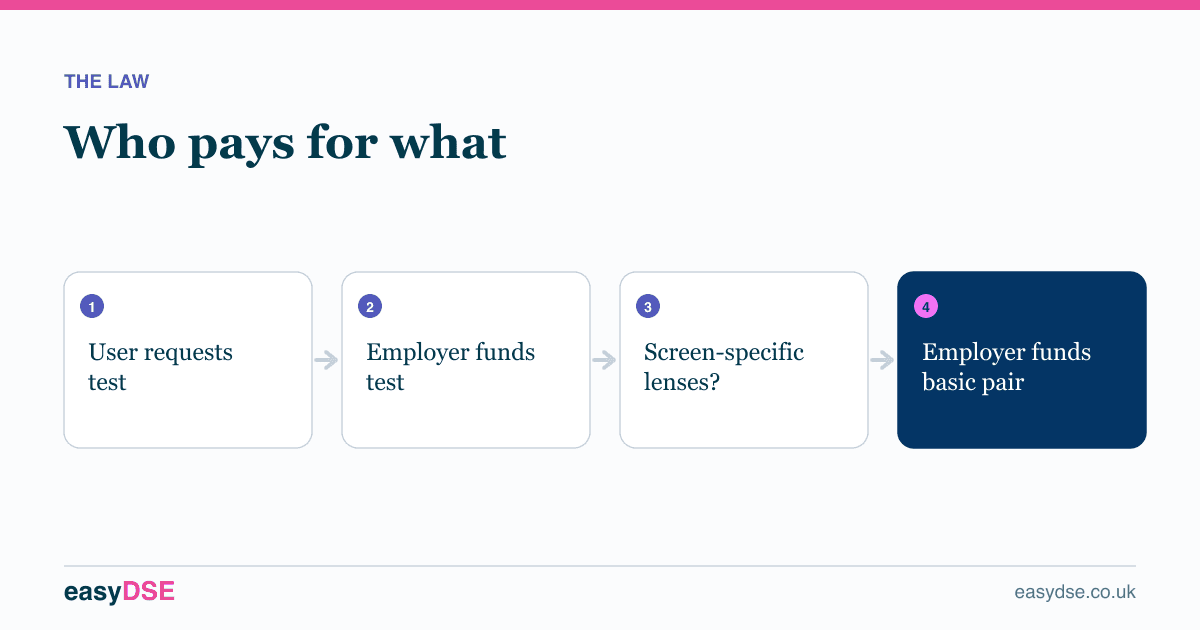
A DSE user who requests an eye and eyesight test is entitled to one paid for by their employer, plus repeat tests at intervals. If glasses are needed specifically for the screen distance, the employer pays for a basic pair. A general prescription is not the employer’s cost.
Eye tests are the DSE duty small employers most often get wrong, usually by being either too generous or completely unaware. Regulation 5 is short and the boundaries are clearer than most people expect.
The entitlement
If someone you have classed as a DSE user asks for an eye and eyesight test, you must provide one at your cost. You must also provide repeat tests at intervals, with the optician advising on what interval is appropriate for that person.
The test has to be a full eye and eyesight test by a competent person, normally an optometrist. A vision screening check is not a substitute, though it can be offered first as a way of identifying who needs the full test.
What you pay for, and what you do not
| Item | Employer pays? |
|---|---|
| The eye and eyesight test itself | Yes, on request |
| Repeat tests at the optician’s recommended interval | Yes |
| Glasses needed specifically for screen distance | Yes, a basic pair |
| A general prescription the person would need anyway | No |
| Designer frames or upgraded lens coatings | No, only the basic cost |
| Contact lenses in place of screen glasses | Not required |
What it costs in practice
Most small employers set a fixed contribution, commonly somewhere between £20 and £50 towards the test and a similar figure towards basic frames and lenses, and publish it. That is simpler to administer than assessing each claim, and it avoids arguments about what counts as basic.
Several high street chains run employer schemes with vouchers, which removes the expenses process entirely. For a business with fewer than twenty screen workers, the annual cost is usually smaller than the admin of managing it ad hoc.
Varifocals and screen work
Varifocals deserve a mention because they cause a specific, common problem. The reading segment sits low in the lens, so someone wearing them at a screen tips their head back and up to find it, and holds their neck there all day.
If someone in varifocals reports neck pain, the fix is often to lower the screen below the usual eye-level guidance, or to get dedicated occupational lenses set for screen distance. The latter frequently does qualify as screen-specific.
Getting the process right
- Tell your DSE users the entitlement exists. Most do not know, and regulation 7 requires you to inform them.
- Put a simple written policy in place with the amounts you will fund.
- Keep a record of who has had a test and when, so repeat intervals are not missed.
- Make sure the optician knows the test is for DSE purposes, so screen distance is measured.
Frequently asked questions
Do employers have to pay for glasses for computer work?
Only where the test shows glasses are needed specifically for the screen distance and would not otherwise be required. In that case the employer pays for a basic pair. A general prescription is not the employer’s cost.
How often can an employee request a DSE eye test?
There is no fixed interval in the regulations. The optician recommends an appropriate interval for that individual, and the employer funds repeat tests on that basis.
Can I offer a vision screening check instead of an eye test?
Screening can be offered as a first step, but it does not replace the entitlement to a full eye and eyesight test if the person still wants one.
Assess your own workstation, free
Eight minutes online, with a report you can act on.
Read next
This article is general information about UK health and safety law, not legal advice. Check the current position on the HSE website and take advice where the stakes justify it.