DSE in 2026: what has changed and what has not
· 6 min read
The short answer
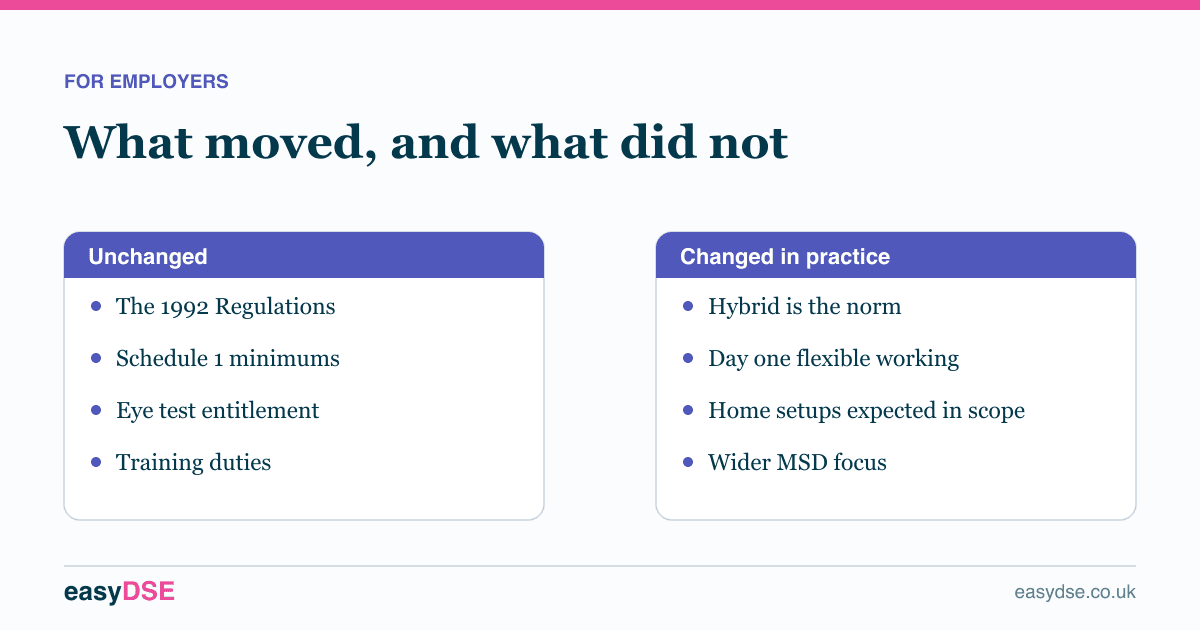
The Health and Safety (Display Screen Equipment) Regulations 1992 have not been substantively amended since 2002. What has changed is the working pattern they apply to: hybrid work is now normal, flexible working is a day one right, and the practical expectation is that home setups are assessed rather than assumed.
Employers ask fairly often whether the DSE rules have changed recently. The short answer is that the regulations have not, and the expectations around them have.
The legislation has not been rewritten
The Health and Safety (Display Screen Equipment) Regulations 1992 were amended in 2002 and have not been substantively changed since. Anyone telling you there is a new DSE Act to comply with is mistaken or selling something.
What has changed is everything the regulations apply to.
Hybrid working became the default
The single biggest practical shift. A large share of UK office work is now split between home and workplace, and the regulations follow the work rather than the premises.
Two consequences for employers. First, most DSE users now have two workstations, both in scope. Second, the home one is usually the weaker, because nobody specified it.
Flexible working became a day one right
Changes to flexible working law removed the previous qualifying period, so employees can request flexible arrangements from their first day. More requests, granted faster, means more home and hybrid setups appearing without a procurement process behind them.
Musculoskeletal health moved up the agenda
Work-related musculoskeletal disorders remain one of the largest categories of work-related ill health in Great Britain, and reducing them sits within HSE’s broader work health strategy. Government interest in occupational health and workforce participation has kept the topic live.
For a small employer, the practical effect is that DSE is less likely to be treated as a paperwork formality and more likely to be asked about.
Assessment tooling got better
A decade ago the realistic options were a paper checklist or an expensive consultancy. Online self-assessment is now normal, and the good implementations prioritise findings, produce a record automatically and chase non-responders.
That matters because the barrier for small businesses was never willingness. It was the administrative overhead of doing it properly for twenty people.
What has not changed at all
- You must assess every DSE user’s workstation.
- You must act on what the assessment finds.
- The Schedule 1 minimums still describe the screen, keyboard, desk, chair, environment and software.
- Users are still entitled to employer-funded eye tests on request.
- Work still has to be planned so screen use is broken up.
- You still have to train and inform people.
What to do this year
- Reassess anyone whose working pattern changed since their last assessment.
- Make sure home setups are covered, not assumed.
- Tie assessment to your flexible working and onboarding processes so it happens automatically.
- Check your records are retrievable and current.
Frequently asked questions
Have the DSE regulations changed recently?
The Health and Safety (Display Screen Equipment) Regulations 1992 were amended in 2002 and have not been substantively changed since. What has changed is the working patterns they apply to, particularly hybrid working.
Do I need to reassess DSE for hybrid workers?
Yes. Both the office and home workstations are in scope, and a change in working pattern is exactly the sort of substantial change that triggers a review.
Assess your own workstation, free
Eight minutes online, with a report you can act on.
Read next
This article is general information about UK health and safety law, not legal advice. Check the current position on the HSE website and take advice where the stakes justify it.